Wednesday, November 25, 2009

Gratitude for Inspiration

I am grateful for inspiration in all its forms.
I honor those people who challenge me
to be a better person.
I seek out those books, songs, blogs, classes
and performances that light a fire underneath me.
I fill myself with passion, joy, and creativity.
I am grateful for inspiration.

Serious Mojo Publications | P.O. Box 390373 | Edina | MN | 55439

Tuesday, November 24, 2009

Meditation and Cardiac Benefits


November 20, 2009, 12:47 pm

Can Meditation Curb Heart Attacks?

Richard Patterson for The New York Times Recent research suggests transcendental meditation may be good for the heart.

When Julia Banks was almost 70, she took up transcendental meditation. She had clogged arteries, high blood pressure and too much weight around the middle, and she enrolled in a clinical trial testing the benefits of meditation.

Now Mrs. Banks, 79, of Milwaukee, meditates twice a day, every day, for 20 minutes each time, setting aside what she calls “a little time for myself.”

“You never think you’ve got that time to spare, but you take that time for yourself and you get the relaxation you need,” said Mrs. Banks, who survived a major heart attack and a lengthy hospitalization after coronary artery bypass surgery six years ago.

“You have things on your mind, but you just blot it out and do the meditation, and you find yourself being more graceful in your own life,” she said. “You find out problems you thought you had don’t exist — they were just things you focused on.”

Could the mental relaxation have real physiological benefits? For Mrs. Banks, the study suggests, it may have. She has gotten her blood pressure under control, though she still takes medication for it, and has lost about 75 pounds.

Findings from the study were presented this week at an American Heart Association meeting in Orlando, Fla. They suggest that transcendental meditation may have real therapeutic value for high-risk people, like Mrs. Banks, with established coronary artery disease.

After following about 200 patients for an average of five years, researchers said, the high-risk patients who meditated cut their risk of heart attacks, strokes and deaths from all causes roughly in half compared with a group of similar patients who were given more conventional education about healthy diet and lifestyle.

Among the roughly 100 patients who meditated, there were 20 heart attacks, strokes and deaths; in the comparison group, there were 32. The meditators tended to remain disease-free longer and also reduced their systolic blood pressure by five millimeters of mercury, on average.

“We found reduced blood pressure that was significant – that was probably one important mediator,” said Dr. Robert Schneider, director of the Institute for Natural Medicine and Prevention, a research institute based at the Maharishi University of Management in Fairfield, Iowa, who presented the findings. The study was conducted at the Medical College of Wisconsin in Milwaukee, in collaboration with the institute.

An earlier study of high-risk Milwaukee residents, many of them overweight or obese, also found transcendental meditation, along with conventional medications, could help reduce blood pressure. Most of those in the study had only high-school educations or less, about 40 percent smoked and roughly half had incomes of less than $10,000 a year.

The participants found transcendental meditation easy to learn and practice, Dr. Schneider said.

“Fortunately, it does not require any particular education and doesn’t conflict with lifestyle philosophy or beliefs; it’s a straightforward technique for getting deep rest to the mind and body,” he said, adding that he believes the technique “helps to reset the body’s own self-repair and homeostatic mechanism.”

Dr. Schneider said other benefits of meditation might follow from stress reduction, which could cause changes in the brain that cut stress hormones like cortisol and dampen the inflammatory processes associated with atherosclerosis.

“What is it about stress that causes cardiovascular disease?” said Dr. Theodore Kotchen, associate dean for clinical research at the Medical College of Wisconsin. “Hormones, neural hormones, cortisol, catecholamines — all tend to be elevated in stress. Could they in some way be contributing to cardiovascular disease? Could a reduction in these hormones with meditation be contributing to reduction in disease? We can only speculate.”

Another recent study focusing on transcendental meditation, published in The American Journal of Hypertension, focused on a young healthy population. It found that stressed-out college students improved their mood through T.M., and those at risk for hypertension were able to reduce their blood pressure. Dr. Schneider was also involved in that study, which was carried out at American University in Washington and included 298 students randomly assigned to either a meditation group or a waiting list.

Students who were at risk of hypertension and practiced meditation reduced systolic blood pressure by 6.3 millimeters of mercury and their diastolic pressure by 4 millimeters of mercury on average.

Tuesday, October 27, 2009

11 foods that lower cholesterol

Changing what you eat can lower your cholesterol and improve the armada of fats floating through your bloodstream.

In with the good
Different foods lower cholesterol in various ways. Some deliver soluble fiber, which binds cholesterol and its precursors in the digestive system and drags them out of the body before they get into circulation. Some give you polyunsaturated fats, which directly lower LDL. And some contain plant sterols and stanols, which block the body from absorbing cholesterol.

Oats. An easy first step to improving your cholesterol is having a bowl of oatmeal or cold oat-based cereal like Cheerios for breakfast. It gives you 1 to 2 grams of soluble fiber. Add a banana or some strawberries for another half-gram. Current nutrition guidelines recommend getting 20 to 35 grams of fiber a day, with at least 5 to 10 grams coming from soluble fiber. (The average American gets about half that amount.)

Barley and other whole grains. Like oats and oat bran, barley and other whole grains can help lower the risk of heart disease, mainly via the soluble fiber they deliver.

Beans. Beans are especially rich in soluble fiber. They also take awhile for the body to digest, meaning you feel full for longer after a meal. That’s one reason beans are a useful food for folks trying to lose weight. With so many choices — from navy and kidney beans to lentils, garbanzos, black-eyed peas, and beyond — and so many ways to prepare them, beans are a very versatile food.

Eggplant and okra. These two low-calorie vegetables are good sources of soluble fiber.

Nuts. A bushel of studies shows that eating almonds, walnuts, peanuts, and other nuts is good for the heart. Eating 2 ounces of nuts a day can slightly lower LDL, on the order of 5%. Nuts have additional nutrients that protect the heart in other ways.

Vegetable oils. Using liquid vegetable oils such as canola, sunflower, safflower, and others in place of butter, lard, or shortening when cooking or at the table helps lower LDL.

Apples, grapes, strawberries, citrus fruits. These fruits are rich in pectin, a type of soluble fiber that lowers LDL.

Foods fortified with sterols and stanols. Sterols and stanols extracted from plants gum up the body’s ability to absorb cholesterol from food. Companies are adding them to foods ranging from margarine and granola bars to orange juice and chocolate. They’re also available as supplements. Getting 2 grams of plant sterols or stanols a day can lower LDL cholesterol by about 10%.

Soy. Eating soybeans and foods made from them, like tofu and soy milk, was once touted as a powerful way to lower cholesterol. Analyses show that the effect is more modest — consuming 25 grams of soy protein a day (10 ounces of tofu or 2½ cups of soy milk) can lower LDL by 5% to 6%.

Fatty fish. Eating fish two or three times a week can lower LDL in two ways: by replacing meat, which has LDL-boosting saturated fats, and by delivering LDL-lowering omega-3 fats. Omega-3s reduce triglycerides in the bloodstream and also protect the heart by helping prevent the onset of abnormal heart rhythms.

Fiber supplements. Supplements offer the least appealing way to get soluble fiber. Two teaspoons a day of psyllium, which is found in Metamucil and other bulk-forming laxatives, provide about 4 grams of soluble fiber.

Out with the bad
Harmful LDL creeps upward and protective HDL drifts downward largely because of diet and other lifestyle choices. Genes play a role, too — some people are genetically programmed to respond more readily to what they eat — but genes aren’t something you can change. Here are some steps you can take:

Saturated fats. One way to lower your LDL is to cut back on saturated fat. Try substituting extra-lean ground beef for regular; low-fat or skim milk for whole milk; olive oil or a vegetable-oil margarine for butter; baked fish or chicken for fried.

Trans fats. Trans fats boost LDL as much as saturated fats do. They also lower protective HDL, rev up inflammation, and increase the tendency for blood clots to form inside blood vessels. The Institute of Medicine recommends getting no more than two grams of trans fats a day; less is even better.

Weight and exercise. Being overweight and not exercising affect fats circulating in the bloodstream. Excess weight boosts harmful LDL, while inactivity depresses protective HDL. Losing weight if needed and exercising more reverse these trends.

Copyright 2009 by Harvard University. HEALTHBEAT 10-27-09

Thursday, October 15, 2009

Pumpkin Recipes!

Enticing Pumpkin Recipes from this week's My Vegetarian Times


Morning Pumpkin Coffee Cake

Bake a breakfast treat that looks and tastes like fall.

http://www.vegetariantimes.com/recipes/9935?section=

Savory Pumpkin Quiche

Try this easy, healthful recipe out on kids—they'll love it.

http://www.vegetariantimes.com/recipes/9933?section=

Pumpkin-Coconut Bisque

Taste how well pumpkin goes in a curry-based soup that gets its creaminess from coconut milk.

http://www.vegetariantimes.com/recipes/9240?

Spicy Fall Stew Baked in a Pumpkin

Wow guests with this meal-in-one recipe that makes pumpkin the focal point of a meal.

http://www.vegetariantimes.com/recipes/10829?section=

Thursday, October 8, 2009

Young May Outgrow Bipolar Disorder

Young Adults May Outgrow Bipolar Disorder

30 Sep 2009

Bipolar disorder, or manic-depression, causes severe and unusual shifts in mood and energy, affecting a person's ability to perform everyday tasks. With symptoms often starting in early adulthood, bipolar disorder has been thought of traditionally as a lifelong disorder. Now, University of Missouri researchers have found evidence that nearly half of those diagnosed between the ages of 18 and 25 may outgrow the disorder by the time they reach 30.

"Using two large nationally representative studies, we found that there was a strikingly high peak prevalence of bipolar disorders in emerging adulthood," said David Cicero, doctoral student in the Department of Psychological Sciences in the College of Arts and Science and lead author of the paper. "During the third decade of life, the prevalence of the disorder appears to resolve substantially, suggesting patients become less symptomatic and may have a greater chance of recovery."

By examining the results of two large national surveys, MU researchers found an "age gradient" in the prevalence of bipolar disorder, with part of the population appearing to outgrow the disorder. In the survey results, 5.5 to 6.2 percent of people between the ages of 18 and 24 suffer from bipolar disorder, but only about 3 percent of people older than 29 suffer from bipolar disorder.

"Young adults between the ages of 18 and 24 are going through significant life changes and social strain, which could influence both the onset and course of the disorder," said Kenneth J. Sher, Curators' Professor in the Department of Psychological Sciences and co-author of the study. "During this period of life, young adults are exploring new roles and relationships and begin to leave their parents' homes for school or work. By the mid 20s, adults have begun to adjust to these changes and begin to settle down and form committed relationships."

Researchers predict the prevalence of the disorder also could be affected by brain development, particularly the prefrontal cortex. The prefrontal cortex, the very front part of the brain, is thought to control perception, senses, personality and intelligence. In particular, it controls reactions to social situations, which can be a challenge for people with bipolar disorder.

"The maturing of the prefrontal cortex of the brain around 25 years of age could biologically explain the developmentally limited aspect of bipolar disorder," Cicero said. "Other researchers have found a similar pattern in young adults with alcohol or substance abuse disorders."

While some scholars suggest that the difference could be due to discounting factors such as early mortality, the sheer number of those who are recovering rules out this possibility, Sher said.

The study, "Are There Developmentally Limited Forms of Bipolar Disorder?" was published in the Journal of Abnormal Psychology. It was co-authored by Cicero, Sher and Amee Epler, a doctoral student in the Department of Psychological Sciences.

Source:
Kelsey Jackson
University of Missouri-Columbia

Article URL: http://www.medicalnewstoday.com/articles/165712.php

Main News Category: Bipolar

Also Appears In: Neurology / Neuroscience, Psychology / Psychiatry,

Let life happen... R.M. Rilke

"Let life happen to you.
Believe me: life is in the right, always."

- Rainer Maria Rilke

Friday, September 18, 2009

A Year of Guided Meditations, Daily Om Offering

Daily Om's A Year of Guided Meditations: the collection is a series of 52 guided meditations featuring profoundly positive principles and ways of becoming your highest self. Every week for a year, you will receive a new guided meditation spoken in a soothing voice along with a beautiful musical background and stunning video images of a nature. These high-powered Be-Attitudes are ideals and values to strive for. Each meditation is about a minute long and is spoken in the I AM tense with the understanding that as you repeat it or internally absorb it along with the spoken word, you are coming that much closer to actualizing the idea within you, in the present tense, at this moment. By speaking as if you are already embodying the principle, you are not waiting for it to manifest at a future time and it can truly manifest within you – in the Now.

This is offered with a sliding fee as low as $10! And there are numerous *free* offerings when you enroll in the course.

Link:
A Year of Guided Meditations

Monday, September 7, 2009

New Evidence, the Body Glows


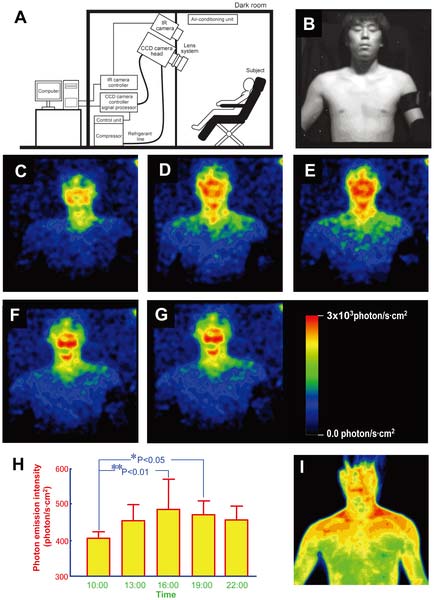
The human body literally glows, emitting a visible light in extremely small quantities at levels that rise and fall with the day.

Past research has shown that the body emits visible light, 1,000 times less intense than the levels which can be seen with the naked eye. In fact, virtually all living creatures emit very weak light.

To learn more about this faint visible light, scientists in Japan employed extraordinarily sensitive cameras capable of detecting single photons. Five healthy male volunteers in their 20’s were placed bare-chested in front of the cameras in complete darkness in light-tight rooms for 20 minutes every three hours.

The researchers found the body glow rose and fell over the day, with its lowest point at 10 AM and its peak at 4 PM, dropping gradually after that. These findings suggest there is light emission linked to the body clock, most likely due to how metabolic rhythms fluctuate over the course of the day.

Faces glowed more than the rest of the body. This might be because faces are more tanned than the rest of the body, since they get more exposure to sunlight.


Sources:
PLoS One July 16, 2009; 4(7): e6256 [Free Full-Text Article]